

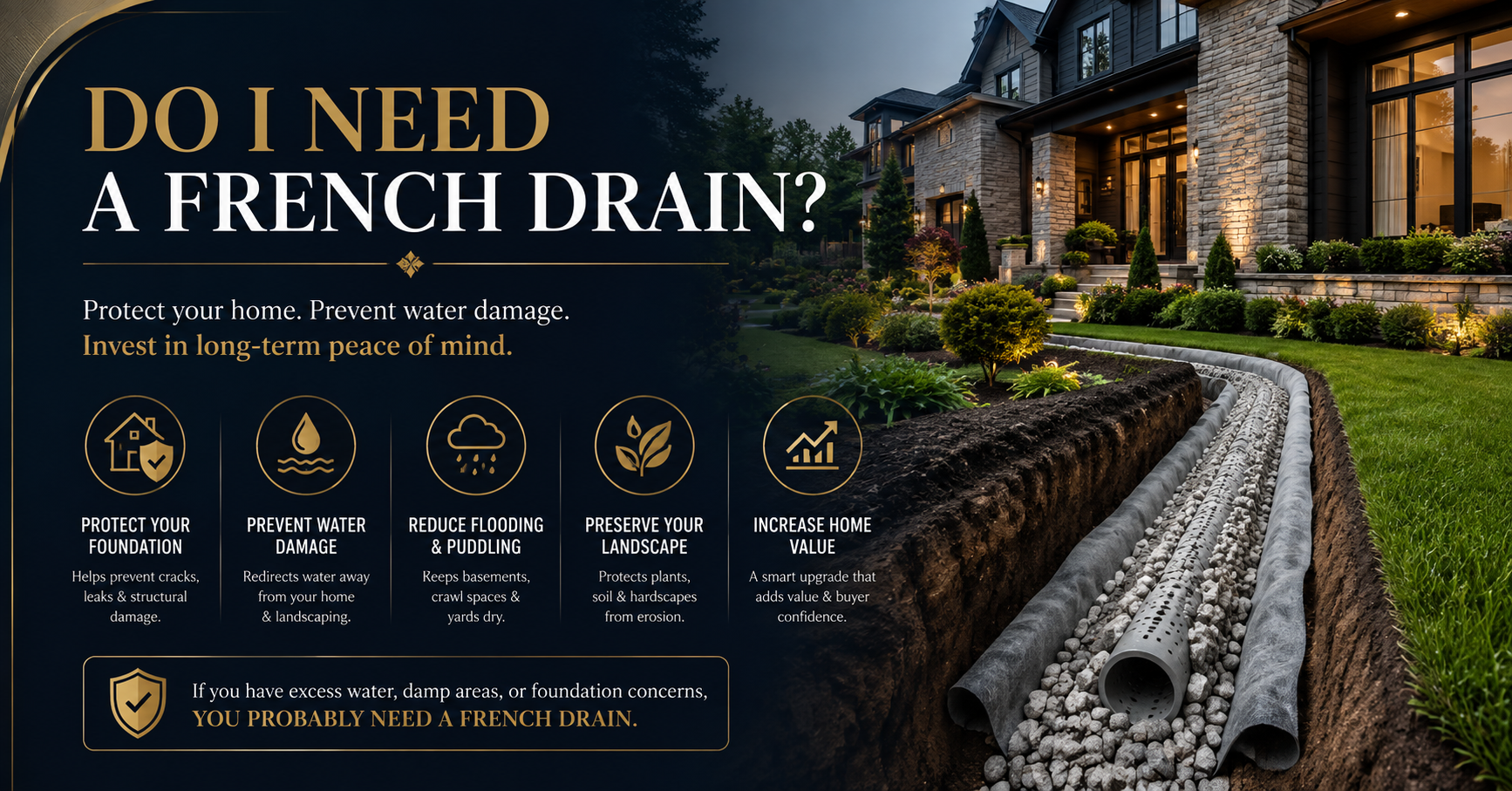
The short answer: you probably need a French drain if water collects underground and lingers, soaking a low spot, a foundation, or a soggy stretch of lawn that never quite dries out. You probably do not need one if your problem is water rushing across the surface, which usually calls for regrading or a surface drain instead. Knowing the difference is the whole game, so let us walk through it the way we would if we were standing in your backyard together.
First, What Is a French Drain, Really?
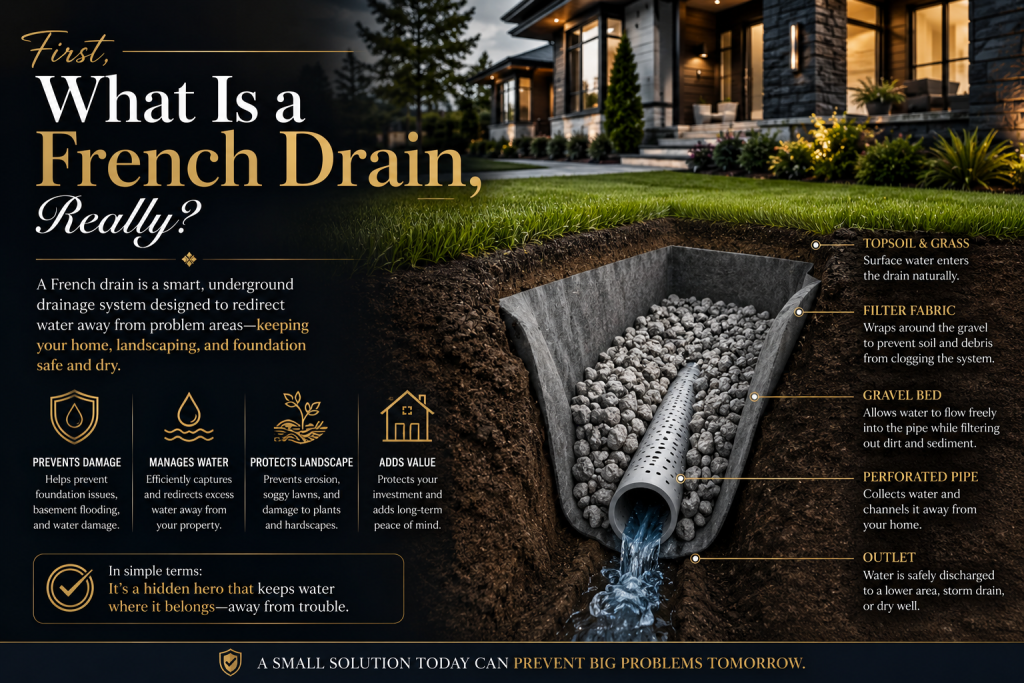
Forget the fancy name. A French drain is just a gravel-filled trench with a perforated pipe running along the bottom. Water seeps down through the gravel, enters the pipe through the holes, and the pipe carries it off to somewhere safe: a lower part of the property, a dry well, or a daylight outlet where it can drain away. That is it. No pumps, no power, no moving parts. Gravity does the work, which is exactly why a French drain lasts for decades when it is built correctly.
The catch is in those last three words. A French drain built without the right slope, the right stone, or a proper fabric wrapper clogs with silt and quits. So while the concept is simple, the install is not a weekend project, and this is one of those jobs where cutting corners you cannot see comes back to bite you.
The Real Question: What Kind of Water Problem Do You Have?
Here is the part most homeowners skip, and it is the most important part. Not every wet yard needs a French drain. Before spending a dollar, figure out which of these two problems you actually have.
Are you dealing with surface water or subsurface water?
Surface water is what you see during the storm: sheets of water running across the yard, pooling on top of the ground, streaming off the driveway. If that is your issue, the fix is usually regrading to change the slope, or a channel drain to catch the flow. A French drain is often the wrong tool here.
Subsurface water is the sneaky one. The ground stays saturated and squishy long after the rain stops. Water shows up in the crawlspace with no obvious entry point. A low area holds moisture for days. That is water moving underground, and that is exactly what a French drain is designed to intercept and carry away.
Nail this distinction and you have already made the smartest decision in the entire project.
Signs a French Drain Is the Right Call
In our experience around Conway and the Grand Strand, a French drain tends to be the answer when we see a handful of telltale signs. Water pooling against the foundation that seeps rather than sheets. A yard that stays spongy underfoot long after everyone else’s has dried. A crawlspace that smells damp or shows moisture with no visible leak. A hillside where water surfaces partway down the slope. Or erosion that keeps carving the same channel because saturated soil below keeps feeding it.
Notice the theme: these are all slow, lingering, below-the-surface problems. That is the French drain’s specialty.
Why Our Local Soil Makes This Common
There is a reason drainage calls are steady in this area. A lot of Horry County sits on flat ground with a high water table and pockets of dense, clay-heavy soil that does not drain well. Flat ground gives water nowhere to run. Clay refuses to absorb it. Put those together after one of our heavy coastal downpours and water simply has nowhere to go, so it sits. That combination is why so many yards here that look fine most of the year turn into a swamp after a big rain, and why a well-placed French drain solves a problem that regrading alone sometimes cannot.
What Goes Into a Drain That Actually Lasts
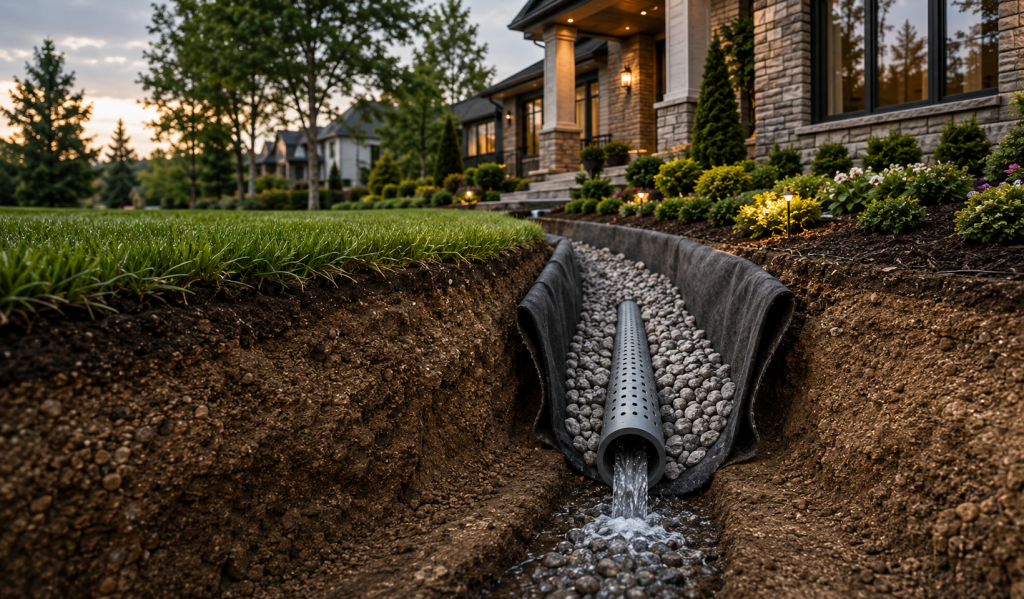
If you take one thing from this article, take this: the French drain you can see when it is finished looks like a strip of gravel. The part that determines whether it works for twenty years or fails in two is all underground. A proper install means a trench cut to a consistent downhill slope so gravity keeps water moving, washed drainage stone rather than dirty gravel that packs tight, a perforated pipe set at the correct depth, and a layer of filter fabric wrapping the whole assembly so soil cannot migrate in and choke it. Skip the slope and water stalls. Skip the fabric and silt fills the pipe. This is precisely why we do not recommend the DIY kits for anything beyond the smallest problem.
French Drain, Regrading, or Both?
Sometimes a French drain is the whole answer. Sometimes it is one piece of a bigger fix. On a flat lot with a saturated low spot, the drain does the heavy lifting. On a yard where water both runs across the surface and pools underground, we will often regrade to redirect the surface flow and add a French drain to handle what sinks in. The honest truth is that we cannot tell you which you need from a description alone, because the right answer depends on your slope, your soil, and where the water actually goes. That is what a site visit is for.
Frequently Asked Questions
How much does a French drain cost?
It depends on length, depth, soil conditions and where the water needs to be routed. A short run to fix one wet spot sits at the low end, while a long drain around a foundation with a difficult outlet costs more. Because digging conditions vary so much, a real number needs a look at the property.
How long does a French drain last?
A properly built French drain with washed stone and filter fabric commonly lasts 20 to 40 years. The failures we get called to fix almost always trace back to a missing slope, dirty gravel or no fabric, which lets silt clog the system early.
Can I install a French drain myself?
For a tiny, simple issue, some homeowners do. For anything involving your foundation, a crawlspace or a real slope, we would steer you away from it. The parts that make a drain last, correct fall and proper filtration, are exactly the parts that are hard to get right without the equipment and experience.
Will a French drain fix my wet crawlspace?
Often yes, when the moisture is coming from groundwater saturating the soil around and under the home. A French drain intercepts that water before it reaches the crawlspace. If the source is surface water or a plumbing issue, though, the fix is different, so the cause has to be confirmed first.
What is the difference between a French drain and regrading?
Regrading reshapes the surface to send water where you want it and handles water you can see running across the yard. A French drain captures water moving underground and pipes it away. Many yards need one, some need both, and which applies comes down to whether your problem is on top of the ground or beneath it.
Standing Water Driving You Crazy?
Avant Land Co diagnoses and fixes drainage for homeowners across Conway, Carolina Forest, Loris, Aynor and the wider Grand Strand. We will come look at where your water actually goes and tell you straight whether you need a French drain, regrading, or a combination, then handle the dirt work and the drain as one job.
Call (843) 516-6333 or request your free estimate online.